

Weavix Survey Finds Frontline Manufacturing Workers Are Ready for AI, But Stuck with Outdated Tools
Nearly three-quarters of workers are comfortable with AI-powered tools, yet still communicate via decades-old two-way radios—a disconnect costing manufacturers approximately $15.4 billion annually.
WICHITA, Kan., Jan. 15, 2026 (GLOBE NEWSWIRE) -- As manufacturers scramble to deploy AI across operations, a new survey reveals a plot twist: frontline manufacturing workers are ready and waiting for AI but lack the tools to take advantage of the technology. The inaugural Weavix 2025 State of Frontline Communications survey polled 300 U.S. frontline manufacturing workers on their attitudes toward AI, communication technology, and workplace engagement. The results indicate the barrier to adoption isn't the frontline workforce but the outdated communication equipment.
Manufacturing Workers Embrace AI
The Weavix survey found overwhelming worker acceptance of AI, highlighting that they see practical applications for it on the manufacturing floor. Almost three-quarters (74%) of workers say they are comfortable with the use of AI-powered tools in the workplace. Additionally, 87% are comfortable with technology systems collecting work data for safety and efficiency purposes. When asked about AI-powered real-time language translation between workers who speak different languages, 78% said it would be somewhat to extremely valuable. In addition, 84% believe technology could help solve communication problems in their workplace.
While relatively few workers expressed concern about AI adoption overall, job security was the primary worry among those who did (32%), suggesting that hesitation stems from economic anxiety rather than technological resistance.
“There's a persistent assumption that frontline workers aren't ready for advanced technology, but our data proves the opposite,” says Kevin Turpin, CEO and founder of Weavix. “Workers are comfortable with AI and data collection, but their leaders have hamstrung them with prehistoric communication devices or nothing at all, wasting time and creating risks. Heading into 2026, frontline workers feel safer and more engaged than ever. The only question is whether manufacturers can meet their needs in the moment.”
The $15 Billion Productivity Drain
Despite worker readiness for advanced technology, 67% still rely primarily on outdated two-way radios for communication. The cost of this infrastructure gap is staggering. The survey reveals that 53% of manufacturing workers lose at least 5% of their workday, or roughly 24 minutes per shift, waiting for safety-critical information or approvals. Of those experiencing idle time, 63% report that it affects their ability to meet production targets. Applied across the 12.7 million U.S. manufacturing workforce, this represents $15.4 billion in direct annual productivity loss at current median wage rates, before accounting for secondary costs like quality defects or safety incidents.
The Smartphone Ban Tradeoff
The survey found that 64% of frontline workers operate under partial or complete smartphone restrictions on the production floor. Manufacturers often implement policies for safety, security, and focus, but they can also remove everyday communication and documentation capabilities— especially when teams need to capture and share information quickly and consistently.
The results point to an emerging need for a purpose-built, modern industrial device: a dedicated “smart radio” that is as simple to use as a legacy two-way radio, but designed for today’s operational realities—supporting real-time coordination and controlled information sharing without becoming an added risk on the production floor.
Additional Findings
The survey revealed several other workforce dynamics manufacturers should monitor in 2026:
- Knowledge transfer at risk: Workers with 20+ years of experience are the least likely to feel that their feedback reaches decision-makers (29% vs. 43% among mid-career workers). As these long-tenured employees approach retirement, companies may be losing both institutional knowledge and their willingness to share it.
- Innovation pipeline blocked: 62% of workers have suggested process improvements to management, but only 38% feel their ideas or feedback always reach decision-makers.
-
Workforce optimism remains strong: Despite communication challenges, 81% of workers report being more engaged at work than last year, and 94% are optimistic about workplace safety improvements in 2026.
Survey Methodology
The Weavix 2025 State of Frontline Communications survey was conducted with Pollfish in November 2025, polling 300 frontline manufacturing workers across U.S. facilities. Respondents represented diverse roles, facility sizes ranging from under 50 to 1,000+ employees, and industry segments including automotive, food processing, electronics, chemical, and other manufacturing.
About Weavix
Weavix’s mission is to connect every disconnected worker. Born in the field, not the boardroom, we understand the daily challenges industrial teams face because we’ve lived them. This real-world experience drove us to create Walt – the world’s most advanced frontline engagement and communications system, leveraging the power of AI. Weavix serves customers across manufacturing, construction, and hospitality, including Kraft, Panasonic, and Hanes. For more information, visit www.weavix.com.
Media Contact:
Aaron Cohen
Vice President of Corporate Communications and Brand
acohen@weavix.com
Phone: +1-415-819-7791
A photo accompanying this announcement is available at https://www.globenewswire.com/NewsRoom/AttachmentNg/ac2d9e44-917a-40db-b7f4-2f6e1236dd02


2025 Weavix State of Frontline Communications Survey
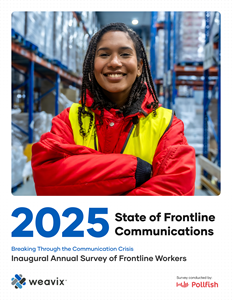
The 2025 Weavix State of Frontline Communications survey found that 74% of manufacturing workers are comfortable with AI-powered tools despite relying on outdated or no communication technology.
Legal Disclaimer:
EIN Presswire provides this news content "as is" without warranty of any kind. We do not accept any responsibility or liability for the accuracy, content, images, videos, licenses, completeness, legality, or reliability of the information contained in this article. If you have any complaints or copyright issues related to this article, kindly contact the author above.
