

BrightEdge Research: Google AI Cites Facebook in 19.5 Million Answers as Social Platforms Become AI Discovery Sources
New data from BrightEdge shows Google AI turning to Facebook and Instagram to help answer consumer questions about local businesses, events, entertainment and cultural moments.
SAN MATEO, Calif., July 20, 2026 (GLOBE NEWSWIRE) -- BrightEdge, the global leader in enterprise organic search, content, and AI discovery, today released new data showing Google’s AI is drawing a significant volume of information and recommendations from social platforms, with Meta properties emerging as a top source.
In a study powered by BrightEdge AI Hyper Cube representing approximately 300 million monthly searches, Facebook appeared as a source in 19.5 million AI Overviews, while Instagram was referenced 877,000 times. One in 15 searches is answered using social media, making Meta properties the primary resource for AI Overviews.
The findings show that Google’s AI is behaving less like a traditional search results page and more like an investigative research layer, looking beyond a brand’s own website to draw from the broader digital conversation around a topic. That can include social posts, videos, community discussions, creator content and other external sources that help AI form a richer answer.
A consumer asking about a nearby restaurant, an upcoming event, a product promotion or a celebrity could receive an AI-generated answer informed by content first published on Meta social platforms, without ever opening Facebook or Instagram.
Facebook for timely information, Instagram for culture and discovery
BrightEdge’s AI Hyper Cube found that Google’s AI does not treat social content as one broad category. Instead, it appears to draw on different social platforms for different types of information, creating a new map of where brands need to understand and optimize social visibility in the AI era.
Facebook frequently appeared in AI Overviews for timely, practical and community-driven information, including sports updates, product recalls, store closures, television schedules and local promotions. Examples include “Cam Skattebo injury,” “Kia K5 recalls,” “is Six Flags closed,” “when does the Love Is Blind reunion air,” “free chicken sandwich Wingstop” and “Pokemon Go Twitch codes.”
Instagram played a different role, appearing more often in answers about culture, entertainment, food, travel and shopping. Examples included “Taylor Swift engagement ring,” “Sydney Sweeney jeans ad,” “baked potato chips,” “Starbucks brown sugar shaken espresso,” “ferry to Amalfi Coast,” and “Home Depot tool deals Milwaukee Ryobi.”
To identify these patterns, BrightEdge leveraged its AI Hyper Cube to analyze broad groups of related questions and prompts, then examined which sources recur across the resulting AI answers. This creates a topic-specific view of the experts, creators, accounts, posts, videos and community sources AI systems repeatedly consult. BrightEdge then combines those source patterns with search and prompt-demand data to identify the experts influencing the questions that matter most in a given industry.
“Google’s AI has a social side, and that changes how brands need to think about visibility,” said Jim Yu, CEO of BrightEdge. “Different platforms appear to matter for different topics. A Facebook post, Instagram video, TikTok trend, Reddit thread or YouTube walkthrough can each shape the answer someone receives from Google. Marketers need to know which social sources matter for their category, what topics they influence, and which specific voices, accounts and content they should engage with as AI becomes a primary discovery channel.”
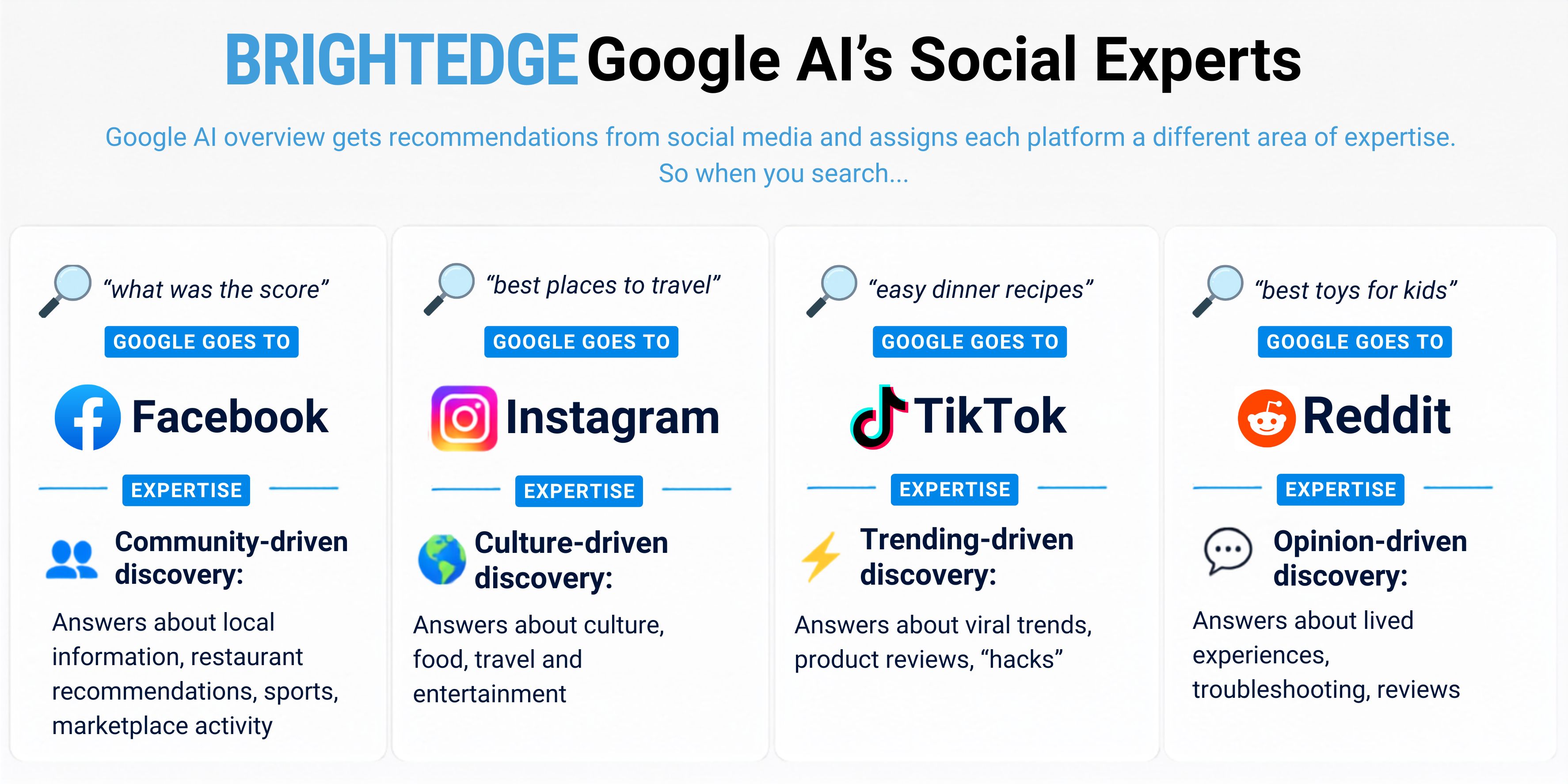
Google AI’s social experts
Google AI does not treat social media as one interchangeable source. It is effectively assigning different platforms to different areas of authority. Like an investigator building context, Google AI appears to consult different types of sources depending on the question being asked.
Analysis from BrightEdge shows Google AI is effectively treating each social platform like an “expert” for different categories: Facebook for local and community signals, Instagram for lifestyle and culture, TikTok for viral trends and deals, Reddit for firsthand experiences and YouTube for instructional context.
The data also reveals the specific social posts and videos Google surfaces for individual questions. For example, an Instagram post appeared as a top source for “mobile payment app,” a topic with an estimated 18.5 million searches in June. For “where to watch Milwaukee Brewers vs. Cincinnati Reds,” (an estimated 11.6 million searches in June), Google surfaced a post by the Cincinnati Reds on Facebook.
In its analysis, BrightEdge also detected 78,000 separate TikTok citations in Google AI Overviews. The data also shows which specific videos Google surfaced for individual questions, including a TikTok video used in an AI answer for “Yankees vs. Dodgers,” a topic with an estimated 2.37 million searches in June. Other examples include “braids,” “dubai chocolate brownie crumbl,” “ad-free music streaming,” and “amazon resale store.”
“AI search is changing what counts as a source of truth,” Yu added. “The brand website remains foundational, but AI engines are also looking at the broader digital conversation. Marketers need to know which sources AI relies on for the questions that matter in their category. For a restaurant, that may be a local Facebook group, an Instagram creator or a review thread. For a retail product, it can be TikTok, Reddit or YouTube. The goal is to understand which voices are shaping AI answers, then build relationships, content and strategy around the sources consumers are actually seeing.”
What this means for marketers
For marketers, the opportunity is not simply to know that Instagram or Facebook matters. It is to understand which specific post, creator, account or community source is influencing an AI answer for a high-value topic, and how that source compares with more obvious signals such as follower count or brand-owned content. This creates two challenges for marketers: understanding what AI engines are using to form answers and knowing how to act on that intelligence. BrightEdge addresses both by showing where AI is drawing authority from and recommending the specific sources, experts, creators and accounts that brands may need to monitor, engage or optimize around.
For marketers, the implications are clear:
- AI influence is not the same as social visibility. Public posts, videos and conversations, even from sources with small audiences, can influence how Google AI describes brands, products, places, people and events.
- Every platform plays a different role in AI’s trusted expert network. Facebook, Instagram, TikTok, Reddit and YouTube appear to contribute different types of information, making it important for brands to understand which platforms and sources carry topic-level authority in their category.
-
Brand strategy must extend beyond owned channels. Companies can no longer evaluate their influence in AI-generated answers by looking only at their websites or their most visible social accounts. They also need to understand the wider influence graph behind AI answers, including the specific experts, creators, accounts, posts, videos and community sources that AI systems may rely on.
BrightEdge AI Market Pulse tracks AI-driven discovery, referral traffic and automated activity across the public web. BrightEdge’s proprietary data also estimates the number of monthly searches associated with the topics analyzed, helping show how many people are asking the questions where social content appears in Google AI answers.
Powered by BrightEdge’s proprietary data and AI intelligence, including analysis from AI Hyper Cube, BrightEdge helps marketers identify which websites, social platforms, community forums, videos and third-party sources influence AI-generated answers by topic and category. BrightEdge data shows where and how AI engines are using social sources; BrightEdge recommendations then help marketers act on that intelligence by identifying the precise experts, creators, accounts, posts, videos or community sources that may influence high-value answers. This helps brands understand which voices AI is relying on, where they may need to engage, and how to strengthen the broader digital presence that shapes what consumers discover through AI.
This gives brands a clearer view of where authority is forming, which sources matter most, and how to optimize their broader digital presence for AI discovery.
To access the full research findings, reporters and analysts can visit the BrightEdge website.
About BrightEdge
BrightEdge is the global leader in Enterprise SEO and AI-powered content performance. For more than 18 years, BrightEdge has helped thousands of brands and digital marketers, including 57% of the Fortune 500, transform online opportunities into measurable business results. Its industry-first platform integrates the most comprehensive dataset in search, combining insights from traditional SEO, digital media, social, and content with cutting-edge generative AI capabilities, including its deep learning engine DataMind and AI Catalyst platform. Trusted by enterprises, mid-market companies, and leading digital agencies, BrightEdge continues to set the standard for innovation in search and AI, enabling brands to win by becoming an integral part of the digital experience.
CONTACT:
press@brightedge.com
A photo accompanying this announcement is available at https://www.globenewswire.com/NewsRoom/AttachmentNg/fc379f62-ced4-48a0-a440-b827ebddb939


BrightEdge: Google AI's social experts
Google’s AI is drawing information and recommendations from social platforms, with Meta properties emerging as a top source.
Legal Disclaimer:
EIN Presswire provides this news content "as is" without warranty of any kind. We do not accept any responsibility or liability for the accuracy, content, images, videos, licenses, completeness, legality, or reliability of the information contained in this article. If you have any complaints or copyright issues related to this article, kindly contact the author above.
